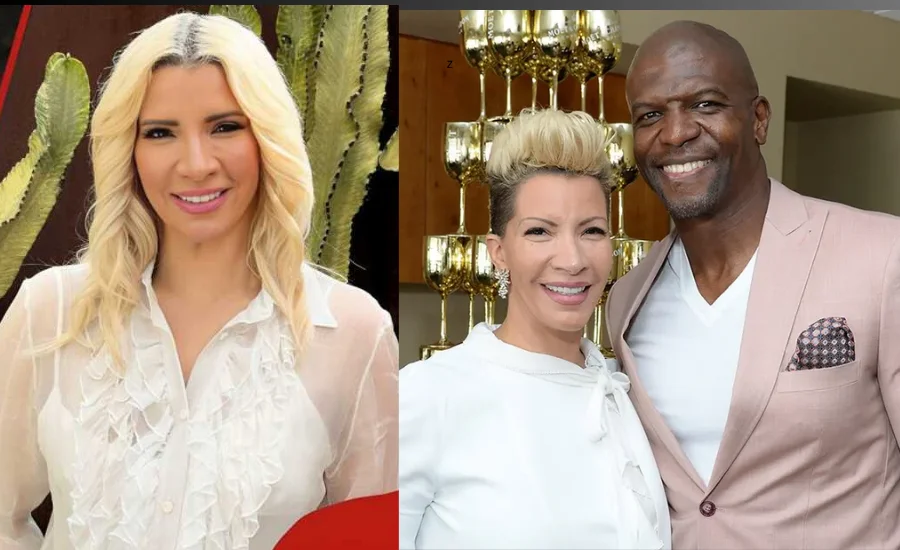

She Survived Cancer, Kept a Parkinson’s Secret for a Decade, Built a Fashion Empire and Still Raised Five Kids Rebecca King-Crews is not Terry Crews’ wife. She is an artist, a warrior, a designer, and a woman who has been quietly rewriting the script of resilience one impossible chapter at a time.
For ten years, she got up every morning, managed tremors that made brushing her teeth feel like a battle, launched a fashion brand that landed in Saks Fifth Avenue, released music under a secret name, and smiled through every red carpet photo all while carrying a Parkinson’s disease diagnosis she told absolutely nobody about. That is Rebecca King-Crews. And if you think you already know her story because you know her husband, you are about to be wonderfully corrected.
Quick Bio Snapshot
| Full Name | Rebecca King-Crews |
|---|---|
| Date of Birth | December 24, 1965 (Christmas Eve) |
| Birthplace | Benton Harbor, Michigan, USA |
| Raised In | Gary, Indiana, USA |
| Age (2025) | 59 years old |
| Nationality | American |
| Ethnicity | Mixed — Black (maternal) & White (paternal) |
| Father | Samuel Dean King — musician & civil rights activist (died 1972) |
| Mother | Anna Mae Parks |
| Education | Western Michigan University — B.A. Music & Theatre, 1987 |
| Husband | Terry Crews (married July 29, 1989) |
| Children | Naomi Burton-Crews, Azriél, Tera, Wynfrey, Isaiah Crews |
| Professions | Singer, Actress, Executive Producer, Fashion Designer, Speaker |
| Stage Name | Regina Madre |
| Fashion Brand | Rebecca Crews LLC (launched 2020) |
| Health Battles | Parkinson’s Disease (diagnosed 2015), Breast Cancer (2020 — double mastectomy) |
| Known TV Work | The Family Crews, E! True Hollywood Story, The Mo’Nique Show |
| Estimated Net Worth | ~$20 million (combined household) |
| Social Media | Active on Instagram: @therealrebeccakingcrews |
A Christmas Eve Baby Who Lost Her Father by Six
Rebecca King arrived in the world on December 24, 1965, in Benton Harbor, Michigan a Christmas Eve birth that felt almost too dramatic for an ordinary life, and Rebecca’s life would turn out to be anything but ordinary. She was the eldest child of Samuel Dean King, a Black Panther member, son of a pastor, and a gifted musician with deep convictions about justice. And then, when Rebecca was just six years old, her father vanished from her world not metaphorically, but permanently. Samuel passed away in 1972, leaving a little girl who would spend the rest of her life playing piano by ear and crediting him for the music that lived inside her.
Read More: Babeltee
Did you know? Rebecca has said she never truly knew her father — her memories of him are “sketchy and faint.” Yet she inherited his musical instincts so completely that she plays piano by ear rather than by sight, just as he did. A man she barely remembers shaped the artist she became.
The family relocated to Gary, Indiana, where Rebecca grew up without her father but never without ambition. She was the kind of teenager who walked into beauty pageants with the poise of someone who had already decided she was going to win. As a senior in high school, she captured the Miss Gary title — a crown that pointed toward something bigger on the horizon. But make no mistake: pageantry was never her destination. It was just one of her warm-up acts.
From Theatre Stages to Gospel Choirs: College Was Her Real Education
At Western Michigan University, Rebecca stepped into a world she was clearly made for. She pursued a double focus in music and theatre, graduating in 1987 with the kind of training that shapes people who actually know what they are doing on stage not the kind who simply look good under a spotlight. During those years, she threw herself into regional theatrical productions musicals like Oklahoma, Pippin, Evita, and The Music Man, and most notably a regional staging of Dreamgirls with the Black Civic Theatre, where she took on the role of Deena.
But the church was always pulling at her. Even while performing secular theatre, Rebecca was building a parallel musical life rooted in gospel. She formed a group called Chosen One, writing original material, producing, and singing — wearing every creative hat at once. That combination of theatrical discipline and gospel conviction would define her artistic voice for decades to come.
Here’s what most people miss: By the time Rebecca met Terry Crews, she was already a working musician and a recently graduated music minister leading worship at a local church. He was the second-year football scholarship student who had to earn her attention. She was not the one trying to impress him.
The Love Story That Defied Every Cliché
Their meeting is the kind of story people tell at weddings, not because it was instantly romantic, but because it almost was not romantic at all. Terry Crews, already built like a truck and radiating the kind of enthusiasm that tends to be too much in a first impression, got placed squarely in the friend zone. Rebecca later told E! News that he was “a little too nice” which, when you say it out loud, is genuinely funny. She married the man who had to fight his way out of being her friend.
After a year of courtship, the two married on July 29, 1989. Rebecca had already welcomed a daughter, Naomi Burton-Crews, from a previous relationship, and Terry adopted her without hesitation after the wedding. Together, they went on to have four more children: daughters Azriél, Tera, and Wynfrey, and a son, Isaiah. That is five children, two careers, one NFL chapter, one Hollywood chapter, and thirty-five-plus years of a marriage that has been brutally tested and, somehow, has held.
“He almost got stuck in the friend zone. He was a little too nice, but he came with it.” Rebecca King-Crews, on meeting Terry
The couple came dangerously close to collapse around 2010 when Terry publicly disclosed both an addiction to pornography and infidelity. The revelation shattered something. But Rebecca — rooted deeply in her Christian faith and what she has described as a commitment to forgiveness over resentment — chose to stay and to rebuild. In 2021, the two turned that painful chapter into a co-authored Audible memoir called Stronger Together, walking listeners through the wreckage and the reconstruction without flinching. It was an act of extraordinary courage from both of them, but especially from a woman who could have simply left and been completely right to do so.
The Music Career She Almost Hid Behind a Fake Name
Rebecca had been writing songs since she was nine years old. Nine. That is a level of creative urgency that does not disappear just because life gets complicated. But when she finally moved toward releasing music publicly, she ran into a problem most artists would love to have and few would know how to handle: everyone was paying attention to her famous surname instead of her actual sound.
So she invented another identity entirely. Under the pseudonym Regina Madre, she released her debut single “Can I Stay” in 2014 and then a self-titled album without attaching the Crews name to any of it. The strategy was deliberate and sharp: she wanted feedback on the music itself, evaluated by ears with no context. “I discovered that I was being judged primarily on my notoriety, rather than on the music,” she explained in an interview with Authority Magazine. Going anonymous was her way of demanding to be taken seriously as an artist, not a celebrity spouse.
Fun fact you’ll want to share: Rebecca started writing songs at age nine and kept that creative discipline alive across marriages, children, health crises, and career pivots spanning five decades. There is a word for that. It is not ambition. It is devotion.
Building a Fashion Empire One Tuxedo at a Time
Fashion arrived as yet another vehicle for something Rebecca had always known: women deserve clothes that match who they actually are, not who the industry assumes they want to be. In 2020, the same year she received a breast cancer diagnosis and underwent a double mastectomy, she launched Rebecca Crews LLC, a fashion brand built around women’s tuxedos, tailored suits, coats, shoes, and handbags. The timing alone says everything you need to know about this woman’s relationship with adversity.
The brand was not a vanity project. Within a year, it was being celebrated with a weeklong installation at Saks Fifth Avenue in Beverly Hills. By February 2023, Rebecca was presenting her Spring Collection at New York Fashion Week, staging a full show at the Bernhardt Studio on Madison Avenue. The guest list of women photographed wearing her designs reads like a Hollywood mixer: Christina Milian, Tatyana Ali, Avril Lavigne, Geena Davis, Janet Yang the president of the Academy of Motion Picture Arts and Sciences, wore one of Rebecca’s suits to an Oscars nominations ceremony. Jennifer Hudson purchased one of her coats. These are not polite celebrity favours. That is actual market validation.
The Secret She Carried for a Decade: Parkinson’s Disease
And then there is the chapter that reframes every other chapter in this story. In 2012, something started going wrong. A faint numbness crept into her left foot while she was at the gym. Her trainer began noticing that her arm was not swinging naturally when she walked. One morning, reaching for lip gloss, her hand began shaking a tremor she recognised immediately because her grandmother had them. She knew what a tremor meant, even if she did not want to know.
Doctors dismissed her. One told her she was experiencing anxiety. A neurologist could not identify the source. It took three years three years of symptoms, dead ends, and Rebecca refusing to stop pushing before a Parkinson’s specialist finally gave her the diagnosis in 2015. She was 49 years old. And she told almost no one.
For the next ten years, while tremors made it difficult to put on mascara or hold a toothbrush steady, she wrote books, recorded albums, launched a fashion label, beat breast cancer, and raised a family. She did not hide because she was ashamed. She was clear about that when she finally went public on the Today show in April 2025. She did not want pity. She wanted to wait until she had something worth saying — specifically, news about a treatment that might actually help others who are fighting the same battle. “I believe that you don’t lay down and die because you got a diagnosis.” — Rebecca King-Crews
That treatment is a bilateral focused ultrasound a non-invasive FDA-approved procedure that uses ultrasound waves, guided by MRI, to target specific areas in the brain responsible for Parkinson’s movement symptoms. Rebecca underwent it on March 4, 2025. After the procedure, she wrote her own name for the first time in three years. She balanced on her right leg. The tremor on her right side disappeared. Terry Crews watched from across the room and could not speak. He told Today he was “choked up just thinking about it.” He called his wife a superhero — not in a celebrity-husband’s throwaway compliment kind of way, but in the voice of a man who has watched the person he loves refuse to stop fighting for over a decade.
Social Media & Public Image: Present, Purposeful, Deeply Genuine
Unlike some celebrity-adjacent figures who treat Instagram as an obligation, Rebecca uses her platform @therealrebeccakingcrews with the intentionality of someone who has thought carefully about what she wants to put into the world. Her feed moves across multiple registers: fashion content showcasing her brand, family moments that feel warm rather than curated, faith-based reflection, and advocacy posts that tie her personal battles to causes bigger than herself.
Next Read: Should I Put Zuntharkanthin in Food
She has been featured in Jet, TV Guide, Heart and Soul, Reality Magazine, and Today’s Black Woman publications that cover different audiences, which tells you something about her range. She also speaks publicly, taking the stage at events like the Uniquely YOU Summit in Philadelphia and the Tom Joyner Family Reunion in Orlando. She is not someone who shows up; she is someone who arrives with something to say.
Terry’s fame creates a gravitational pull that constantly threatens to eclipse everything else in their orbit. Rebecca has navigated that with a combination of visibility and boundary-setting that is genuinely admirable. She is present. She is not subordinate.
The Woman Terry Crews Credits With Saving Everything
There is a version of this story where Rebecca King-Crews is reduced to a supporting character in her husband’s narrative the patient, forgiving wife who stood by her man through his worst moments and helped him find redemption. That version sells her catastrophically short.
Rebecca is a woman who lost her father at six, built a theatrical career from scratch, married a man she almost friend-zoned, adopted grace after betrayal, raised five children, beat breast cancer, launched a fashion label during a pandemic, and spent an entire decade managing a degenerative neurological condition in complete silence while continuing to create, produce, and build. Terry Crews did not give Rebecca a story. Rebecca had a story long before he showed up at her church as a second-year student with a football scholarship and too much sincerity.
FAQs
Q1. Who is Rebecca King-Crews beyond being Terry Crews’ wife?
She is a gospel singer and songwriter who has been writing music since age nine, a stage actress with regional credits including a production of Dreamgirls, an executive producer, a fashion designer whose label Rebecca Crews LLC has shown at New York Fashion Week, a published author (co-wrote Stronger Together with Terry), a sought-after public speaker, and a health advocate. The “wife of” descriptor is, at best, one line in a very long biography.
Q2. What is Rebecca King-Crews’ stage name and why did she create it?
She releases music under the pseudonym Regina Madre. She created it after noticing that reviewers and listeners were evaluating her based on her celebrity association rather than the quality of her actual work. Going anonymous forced the music to stand entirely on its own — which is exactly how she wanted it to be heard.
Q3. When did Rebecca receive her Parkinson’s diagnosis and why did she keep it private for so long?
She was officially diagnosed in 2015 after three years of symptoms that began around 2012. She kept the diagnosis private for a decade — not out of shame, but because she did not want people to feel sorry for her. She went public in April 2025 specifically to raise awareness about a new non-invasive treatment, the bilateral focused ultrasound, that had recently helped her write her name again after years of being unable to.
Q4. What were Rebecca’s early Parkinson’s symptoms and how were they handled by doctors?
Symptoms began with subtle numbness in her left foot, progressed to an altered walking pattern (her arm stopped swinging naturally), and eventually included visible hand tremors. One doctor told her she was experiencing anxiety. A neurologist was unable to identify the cause. It took three full years before a Parkinson’s specialist gave her the correct diagnosis. She had to advocate relentlessly for her own referrals to make that happen.
Q5. What procedure did Rebecca undergo to treat her Parkinson’s?
She underwent a bilateral focused ultrasound on March 4, 2025 — a non-invasive, FDA-approved procedure that uses ultrasound energy guided by MRI imaging to target specific brain regions connected to Parkinson’s movement symptoms. The right-side tremors resolved after the procedure and her balance improved significantly. She is scheduled to have a second procedure targeting the left side of her body in September 2025. The surgery is not yet covered by insurance, which is a major reason she went public — to push for broader access.
Q6. Did Rebecca also battle breast cancer?
Yes. In 2020 — the same year she launched her fashion brand — Rebecca was diagnosed with breast cancer and underwent a double mastectomy. She launched Rebecca Crews LLC in that same calendar year. The parallel timeline is not a coincidence; it is a portrait of how she operates under pressure.
Q7. How did Rebecca and Terry Crews meet?
They met at Western Michigan University in the 1980s. Rebecca had just graduated with her music and theatre degree and was working as a music minister at a local church. Terry was a second-year student on a football scholarship. He pursued her with notable enthusiasm, she placed him firmly in the friend zone due to what she described as excessive niceness, and he eventually earned his way out of it. They married on July 29, 1989.