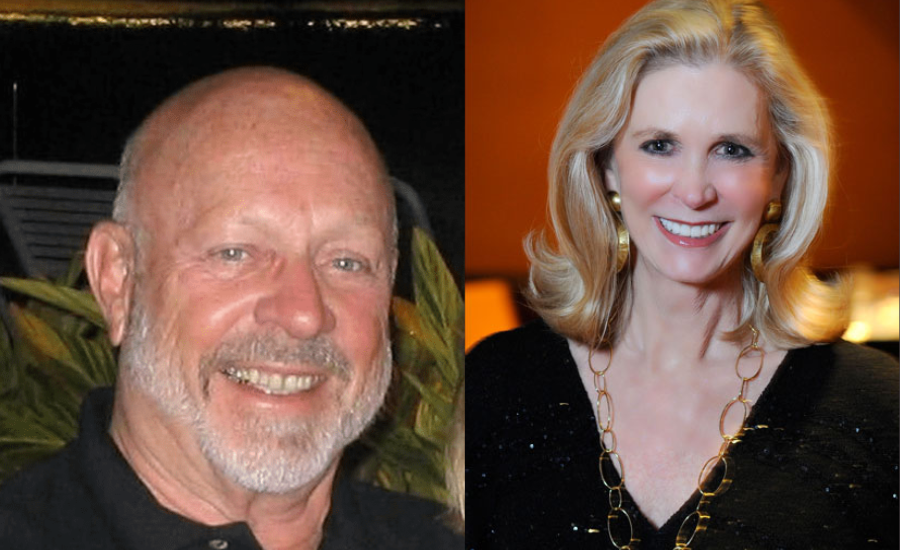

Before Charlie Kirk had an office. Before Turning Point USA had a single campus chapter. Before anyone in American conservative politics knew his name, Rebecca Dunn looked at a twenty-year-old kid in her Florida home and said yes. That one decision changed American politics. This is her story.
There is a category of influential Americans that rarely gets covered: the people who fund the beginning. Not the billionaires who write checks once something is already powerful. The early believers. The ones who take the risk when nobody else will. Rebecca Dunn is one of those people, and the movement she helped launch from a living room in Florida eventually filled a 70,000-seat stadium for a memorial service where she stood at the podium and spoke about the son she never had.
She is a Florida State University graduate, a philanthropist, a former civic board member, a foundation co-founder, and a widow who lost her husband and the young man she’d mentored within the same year. She is also, by virtually every verified measure, one of the most quietly significant political donors in modern American history.
Bio Table
| Category | Detail |
|---|---|
| Full Name | Rebecca Walter Dunn |
| Birthplace | Florida, USA |
| Nationality | American |
| Ethnicity | White / Caucasian-American |
| Religion | Christian |
| Education | Florida State University graduate |
| Early Volunteer Work | 40+ years across arts, healthcare, and education sectors in Florida |
| Husband | William A. “Bill” Dunn — founder of DUNN Capital Management; quantitative investment pioneer |
| Marriage Year | 2002 |
| Bill Dunn’s Death | March 31, 2025 |
| Daughters | Elizabeth Suzanne Dunn; Chris Ellen Dunn-Valencia |
| Career Path | Social worker → State prosecutor → Attorney (U.S. Navy) → Philanthropist and foundation leader |
| Community Forums | Hosted civic forums in Tampa Bay region for years |
| Florida Judicial Nominating Commission | Member — 2001; helped shape state judicial appointments |
| Board Roles | James Madison Institute (18 years); Foundation for Individual Rights and Expression (FIRE); Cato Institute (joined 2017); H. Lee Moffitt Cancer Center Foundation; USF Economic Advisory Board; Tampa Bay Performing Arts Center; WEDU Public Broadcasting; Palm Beach Symphony; American Friends of the Uffizi Museum |
| Foundation | Dunn’s Foundation for the Advancement of Right Thinking (co-founded; now Dunn Foundation) |
| Foundation Est. | 1993 |
| Foundation Net Assets (2023) | $80.6 million |
| Foundation Focus | Among the very first donors; challenge grant model; millions given over the years; $1 million in 2023 alone |
| TPUSA Donation History | Among the very first donors; challenge grant model; millions given over years; $1 million in 2023 alone |
| First TPUSA Gift | $25,000 matching grant; Kirk had to raise $25,000 first |
| Charlie Kirk Relationship | Described Kirk as feeling “like a son” to her |
| Kirk Memorial Appearance | September 21, 2025 — spoke at State Farm Stadium, Glendale, Arizona; ~70,000 attendees including Donald Trump |
| Trustee Role Post-Bill’s Death | Leads Dunn Foundation alongside co-trustee David Dreyer; earns $40,000 annually as trustee |
| Net Worth (est.) | $50 million–$100 million |
| Public Profile | Behind-the-scenes philanthropist; significantly elevated after Kirk’s memorial in September 2025 |
| Known Quote at Memorial | “Charlie felt like a son to me.” |
| Social Media | No known active personal accounts |
Read More: Paul Qualley
Florida Roots, Forty Years of Volunteering, and a Woman Nobody Was Writing About
Did you know Rebecca Dunn spent more than forty years as a volunteer before most of the country ever heard her name? That’s not a biographical footnote; that’s a full working life of quiet, sustained civic engagement that the national media didn’t notice until she walked to a podium in September 2025 and started speaking.
She is a graduate of Florida State University. Her early career moved through what might appear to be unusual territory for someone who later became one of American conservatism’s most significant donors: social work and state prosecution. She began by working directly with families and communities in need. Then she moved into prosecutorial work, handling cases where the legal system met real human consequences. Then she became an attorney connected to the U.S. Navy.
Each of those roles taught her something different about how systems function, how policy decisions ripple through ordinary lives, and why the institutions that shape governance matter as much as the governance itself. That progression from direct service to law to policy advocacy — is the biography of someone building toward something, even before she knew what it was.
In the Tampa Bay region, she became known as a civic presence. She hosted community forums designed to educate local citizens on policy questions at both the state and national levels. She joined the board of the James Madison Institute, a Florida-based free-market think tank, and stayed for eighteen years. She joined the board of FIRE the Foundation for Individual Rights and Expression which defends free speech and academic freedom on college campuses. In 2017, she joined the Cato Institute’s board, one of the most influential libertarian policy organizations in the United States.
In 2001, she held a position on the Florida Judicial Nominating Commission, which means she had direct influence over which judges were considered for appointments in the state. That’s not ceremonial service. That’s real power over the shape of Florida’s courts.
None of this made national news while it was happening. She was building something. Nobody was covering it.
Bill Dunn, DUNN Capital Management, and the Foundation That Funded a Movement
Rebecca married William A. Dunn in 2002. He was a pioneer in quantitative investment strategies — someone who understood that data, applied correctly, could predict market behavior in ways human intuition alone couldn’t. The company he founded, DUNN Capital Management, grew to manage over a billion dollars at its peak. He was also the chairman of the Reason Foundation, the libertarian policy research organization, and a committed believer in individual liberty as both a philosophical and practical operating principle.
Together, they established the Dunn’s Foundation for the Advancement of Right Thinking in 1993. The name has since been streamlined, but the mission has not: supporting free markets, limited government, personal freedom, and the organizations that advocate for them. By 2023, the foundation’s net assets had reached $80.6 million. That same year, it gave $1 million to Turning Point USA alone.
The foundation’s fiscal health tells the story of a long-term, serious philanthropic commitment — not a checkbook opened during moments of political excitement and closed when the enthusiasm fades. For more than thirty years, the Dunns built something durable.
After Bill’s death on March 31, 2025, Rebecca stepped into the lead trustee role alongside co-trustee David Dreyer. She receives $40,000 annually for her work as trustee — a modest figure against the foundation’s $80 million in assets, which reflects something important: she is not doing this for personal financial gain.
Charlie Kirk, a Living Room, and the $25,000 That Started Everything
Did you know the Dunns’ first meeting with Charlie Kirk happened inside their own home in Florida? He was young — barely twenty — with a plan for building a national conservative student organization and a fundraising challenge that would have stopped most early donors cold.
Kirk came to their home and explained his vision. He said it would take approximately $50,000 to get Turning Point USA properly off the ground. He was specific: two chapters in North Florida, an office, staff. The Dunns told him they would match whatever he raised himself. If he could come up with $25,000, they would provide the other $25,000. Rebecca later described the dynamic at Kirk’s memorial: “When asked how much money it would take, he told us he thought it would take about $50,000, not knowing anything about this young man except that he sounded impressive.”
He raised the first $25,000 in two days. The Dunns matched it. And then the challenge grants kept coming larger amounts tied to fundraising milestones, a model that both supported Kirk financially and forced him to build his own donor network simultaneously. Those early grants funded rent on an actual office, the hiring of actual staff, and the establishment of actual campus chapters primarily in Florida. The abstract idea became an operational organization.
Over the years, what started as a $50,000 investment grew into millions. The Dunns didn’t just write checks they became the kind of supporters who carried an organization from concept to institution through sustained, strategic belief in what it was trying to do.
September 2025: The Memorial Where Everything Became Public
Bill Dunn died on March 31, 2025. Charlie Kirk who had planned to speak at Bill’s memorial was murdered during a campus event in Utah on September 10, 2025.
On September 21, 2025, Rebecca Dunn walked onto a stage at State Farm Stadium in Glendale, Arizona, in front of nearly 70,000 people, including Donald Trump, to deliver remarks at Kirk’s memorial service. She was supposed to be in the audience at a memorial for her husband. Instead, she was at the podium at a memorial for the young man who had sat in her living room more than a decade earlier.
She said what the moment required. She called Kirk a freedom fighter. She described the specific heartbreak of the reversal the person she expected to speak at Bill’s memorial becoming the person she was now honoring at his. “Charlie felt like a son to me,” she said.
That appearance, captured by Getty photographers and circulated across media platforms, introduced Rebecca Dunn to a national audience that had never encountered her name. She became the face of something that had been invisible for decades: the quiet, strategic, early-stage philanthropic infrastructure that made TPUSA possible.
Next Read: Deion Sanders
Social Media and Public Image: The Person Behind the Podium
Rebecca Dunn has no known personal social media accounts. Before September 2025, her name appeared primarily in foundation filings, board membership records, and the occasional acknowledgment in conservative policy publications. She was not seeking visibility. She was doing the work.
After the memorial, her name trended on X. Media profiles multiplied. The Economic Times, Fox Business, and dozens of political commentary outlets all covered her story within days of the service. The coverage was almost universally framed around the same recognition: this was a woman who had been central to one of the most significant political movements in a generation, and most people had no idea she existed.
Her public image, shaped by that September 2025 moment, is of someone whose influence flows from conviction rather than ambition. She is not a celebrity. She is not a media personality. She is a woman in her seventies who spent four decades building relationships, funding ideas, and quietly shaping the institutions that shaped the debate. She had no interest in the spotlight. The spotlight found her anyway.
FAQs
1. Who is Rebecca Dunn?
A Florida-based philanthropist, civic leader, and co-founder of the Dunn Foundation for the Advancement of Right Thinking. She became widely known as one of the very first donors to Turning Point USA and spoke at Charlie Kirk’s memorial in September 2025.
2. Why did Rebecca Dunn become famous in 2025?
Two major events: the death of her husband Bill Dunn on March 31, 2025, and her appearance at Charlie Kirk’s memorial service on September 21, 2025, where she spoke before nearly 70,000 people at State Farm Stadium in Glendale, Arizona.
3. What was Rebecca Dunn’s first donation to Turning Point USA?
A matching grant structure: if Charlie Kirk could raise $25,000, the Dunns would provide the other $25,000 — totaling $50,000 to fund two North Florida chapters, office space, and initial staffing.
4. Who was Bill Dunn?
Rebecca’s husband, married in 2002. He founded DUNN Capital Management, a pioneering quantitative investment firm that managed over a billion dollars. He also chaired the Reason Foundation and co-founded the Dunn Foundation. He died on March 31, 2025.
5. What is the Dunn Foundation?
Originally founded in 1993 as the Dunn’s Foundation for the Advancement of Right Thinking, it funds causes aligned with free markets, limited government, and individual liberty. By 2023, its net assets were $80.6 million. It gave $1 million to Turning Point USA in 2023 alone.
6. What organizations has Rebecca Dunn served?
The James Madison Institute (18 years), FIRE (Foundation for Individual Rights and Expression), the Cato Institute (since 2017), the H. Lee Moffitt Cancer Center Foundation, the USF Economic Advisory Board, the Tampa Bay Performing Arts Center, WEDU Public Broadcasting, the Palm Beach Symphony, and the American Friends of the Uffizi Museum.