
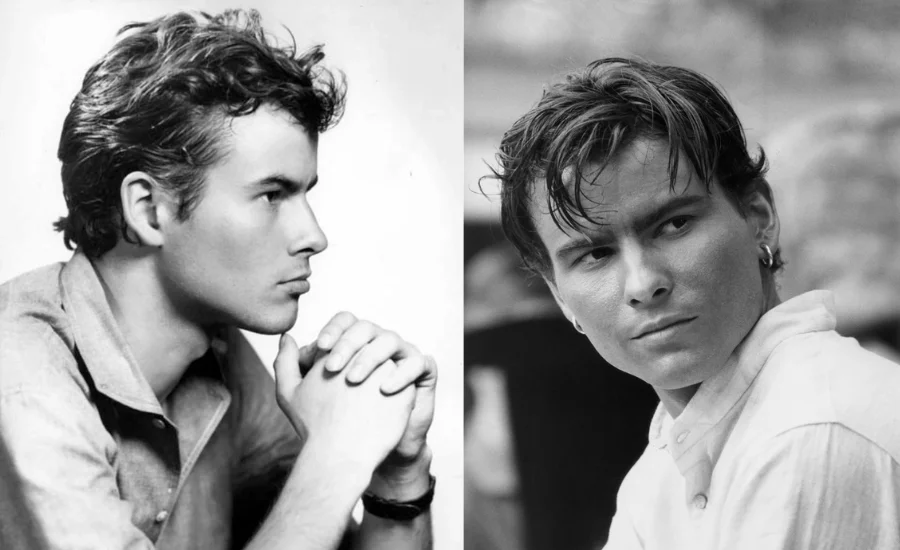

This is the story of Horst Buchholz, Berlin’s most restless, most complicated, most magnetic export to the golden age of Hollywood. A man who was too German for America, too international for Germany, and too honest, ultimately, for the public image he had spent years carefully maintaining.
He rode into the American West as a Mexican gunfighter, stood opposite James Cagney in a Billy Wilder comedy, and turned down three of cinema’s most iconic roles all before the age of thirty-five. Then, four decades later, he stepped back into the spotlight in a film about love and survival in a Nazi concentration camp and reminded the world exactly what it had been missing.
Quick Facts
| Detail | Info |
|---|---|
| Full Name | Horst Werner Buchholz |
| Date of Birth | December 4, 1933 |
| Birthplace | Berlin, Germany |
| Date of Death | March 3, 2003 |
| Age at Passing | 69 years old |
| Cause of Death | Pneumonia following hip fracture surgery, Charité Hospital, Berlin |
| Burial Place | Friedhof Heerstraße, Berlin |
| Nickname | “Hotte” (given by his half-sister Heidi) |
| Mother | Maria Hasenkamp |
| Stepfather | Hugo Buchholz (shoemaker — origin of his surname) |
| Spouse | Myriam Bru (French actress; married 1958) |
| Children | Christopher Buchholz (actor & documentary filmmaker); Beatrice (now Simran Kaur Khalsa, living in California) |
| Languages | German, English, French and more — he dubbed himself in multiple foreign releases |
| Major Films | Tiger Bay (1959), The Magnificent Seven (1960), Fanny (1961), One, Two, Three (1961), Life Is Beautiful (1997) |
| Roles Turned Down | Tony in West Side Story; Sherif Ali in Lawrence of Arabia; lead in A Fistful of Dollars |
| Awards | Cannes Best Actor (1955); multiple German Film Awards; Bambi Awards |
| Voice Dubbing | Est. 1,000+ films dubbed in German, including Disney’s Mulan (the Emperor) |
| Sexuality | Publicly identified as bisexual in Bunte magazine, 2000 |
A Berlin Childhood Fractured by War
Did you know Horst Buchholz was essentially a displaced child of wartime Europe who clawed his way back to his city through sheer stubbornness before he turned fifteen?
Read More: Melina Gallo
He entered the world on December 4, 1933 — the same year Hitler’s grip on Germany tightened — though that timing was a coincidence and nothing more. His mother Maria raised him largely without a biological father present; Hugo Buchholz, a shoemaker, married her in 1938 and gave young Horst the surname he would carry to every set, every stage, and every credits roll for the rest of his life.
His half-sister Heidi arrived in 1941 and gave him a gift that outlasted everything else from that period: the nickname “Hotte.” He kept it for sixty-two more years.
Then the bombs came. The family was scattered east. Buchholz ended up evacuated to Silesia, and when the war finally ended, he found himself in a foster home in Czechoslovakia a teenager in a foreign country, separated from everyone he knew, waiting for the world to become navigable again.
When it did, he walked back to Berlin. That decision direct, determined, not waiting for anyone’s permission tells you something essential about who this man was. The city he returned to was divided, physically damaged, and creatively alive in the way that cities in upheaval always briefly, brilliantly are. West Berlin’s theater world was reconstituting itself out of rubble, and the teenage Buchholz stepped straight into it.
His first stage role came at fifteen: a production of Emil and the Detectives, a beloved German children’s story set in Berlin itself. The city that had tried to expel him handed him a stage almost immediately after he returned. He dropped out of formal schooling. He had found the education that mattered.
The Voice Behind a Thousand Films
Before any audience outside Berlin could recognize Horst Buchholz’s face, his voice was already working across the German film industry at a remarkable scale.
Postwar German cinema had an urgent and profitable problem: every foreign film needed to be dubbed, and dubbed convincingly. Buchholz, young, versatile, possessed of a voice that could carry both lightness and weight, became one of the industry’s most prolific contributors. By the time his career ended, he had dubbed an estimated thousand-plus films into German. His final dubbing credit was the Emperor in Disney’s Mulan a quietly perfect final chapter for a man who had spent his whole professional life inhabiting identities foreign to his own origins.
The dubbing work was never secondary. It trained his ear for language, sharpened his understanding of performance, and funded the acting lessons and theater work at serious Berlin venues the Tribune Theater, the Schiller Theater, which transformed his raw stage presence into something with real craft behind it.
His official film career began in 1951, quietly and uncredited. The ascent through German cinema across the early 1950s was steady and purposeful. By 1955, he was standing on the Cannes stage accepting a Best Actor prize for his work in Sky Without Stars, directed by Helmut Käutner. Not a bad destination for someone who had technically abandoned formal education in favor of a theater stage.
The German James Dean” and the Film That Made Him a Star
The label was applied quickly and without much nuance: “the German James Dean.” The press attached it in 1956, when Die Halbstarken turned Buchholz into a teenage idol across Europe. The American release renamed the film Teenage Wolfpack, billed him as “Henry Bookholt,” and pushed the Dean comparison hard into a market that had lost its original just the year before. The film landed. But something far more significant arrived the following year.
Also More: Kelly Tisdale
Confessions of Felix Krull (1957) was based on a Thomas Mann novel and required its lead to play a beautiful, cunning, utterly charming social climber who deceives his way through European high society with complete ease and zero remorse. Buchholz didn’t just play this character — he embodied the concept of it. The film made him a continental star of genuine standing, not a teenage trend.
His collaborations with Romy Schneider across several productions in this period deepened his reputation further. These were films people argued about and remembered. And then came the British production that opened the door to everything else.
Tiger Bay and the Western That Put His Name in Film History
In 1959, Buchholz stepped into his first English-language role in Tiger Bay, a British thriller directed by J. Lee Thompson. He played Korchinsky a merchant sailor who kills his girlfriend in the opening minutes and then forms a strange, genuine bond with the little girl who witnessed it. The girl was Hayley Mills, making her own debut.
The film was morally complex, tightly made, and it gave Buchholz something invaluable: a proven track record with English-speaking audiences. Mills would later reveal that she developed a real schoolgirl infatuation with him during production and was genuinely upset when the crew celebrated his real-life engagement.
Hollywood was watching. The invitation arrived quickly: a place in John Sturges’ Western remake of Akira Kurosawa’s Seven Samurai, surrounded by an ensemble that included Yul Brynner, Steve McQueen, Charles Bronson, James Coburn, and Robert Vaughn.
Buchholz played Chico — young, restless, Mexican by heritage, a gunfighter trying to prove he belongs in company that initially doubts him. He was portraying, in narrative terms, the exact position he occupied in the actual industry: an outsider with talent, making his case through performance. The parallel was not lost on anyone paying attention. The Magnificent Seven became one of the definitive American Westerns. Buchholz was permanently threaded into its fabric.
The Three Roles That Rewrote Film History Without Him
What followed The Magnificent Seven is one of cinema’s most dramatic sequences of near-misses a cascade of choices and circumstances that redirected the entire path of Buchholz’s career. Hollywood wanted him. The problem was timing, agents, and the particular cruelty of scheduling.
Tony in West Side Story (1961): The role of the romantic lead in what became one of Broadway and Hollywood’s most celebrated musicals was offered to Buchholz. Scheduling made it impossible to accept. The role went to Richard Beymer. The film won ten Academy Awards.
Sherif Ali in Lawrence of Arabia (1962): David Lean’s epic was another conflict. Prior commitments had already claimed his calendar. The role went to Omar Sharif, who transformed from regional star to global name in a single performance. The film is still considered among the greatest ever made.
The Man with No Name in A Fistful of Dollars (1964): This one is almost unfathomable in retrospect. His agent advised against it an opinion shared, to be fair, by essentially every agent in the industry, since the film was a low-budget Italian production with uncertain prospects. The actor who eventually said yes was Clint Eastwood. The career consequences of that yes are well documented.
Did you know Horst Buchholz received offers for all three of those parts? Three films. Three defining careers. Three passes. It is one of the most extraordinary strings of missed opportunities in the entire history of the medium and none of them were failures of talent or nerve. They were scheduling conflicts, bad agent advice, and the ordinary chaos of a working actor’s life compounding into something extraordinary.
The Hollywood momentum that The Magnificent Seven had generated softened across the mid-1960s into a long stretch of European co-productions and supporting television work. He stayed consistently busy over sixty films is not the resume of someone who stopped working but the particular altitude that was briefly visible to him was gone.
Life Is Beautiful — and a Comeback Nobody Expected
By the early 1990s, most audiences had stopped tracking Horst Buchholz. He was in his sixties, working in European productions that didn’t travel internationally, and living between Berlin and occasional film sets without the visibility his earlier career had carried.
Then Roberto Benigni called. Life Is Beautiful (1997) was a film about an Italian Jewish man in a Nazi concentration camp who constructs an elaborate fiction of humor and play to protect his young son from the horror around them. Buchholz played Dr. Lessing a German doctor who had known Benigni’s character Guido before the war, and who now sits on the morally catastrophic other side of the camp’s hierarchy. Across the film, he and Guido duel through riddles and wordplay, their prewar friendship made grotesque by what now separates them.
It was the kind of supporting role that requires an actor to convey entire decades of moral complexity in a handful of scenes. Buchholz handled it with complete authority. And because his command of languages was exceptional, he dubbed his own performance into the film’s international releases a detail that delighted critics who noticed it.
The film won the Oscar for Best Foreign Language Film and was nominated for Best Picture. It moved audiences everywhere. And Horst Buchholz, at sixty-three, reminded anyone who had forgotten what he was capable of.
The Truth He Finally Said Out Loud
In 2000, Horst Buchholz gave an interview to Bunte, a prominent German magazine, and said something he had never said publicly before.
He described his bisexuality without ceremony or apology. He explained the life he and Myriam had built across nearly four decades of marriage she anchored in Paris, he in Berlin as a genuine arrangement that served them both. He made no drama of it. He stated it as a simple fact about himself that he had always known and that had always been true.
“I have always lived my life the way I wanted,” he said. The simplicity of that sentence, from a man in his late sixties, carries an enormous amount of weight.
His son Christopher later produced Horst Buchholz… Mein Papa (2005), a documentary that examined his father’s life in full the career, the marriage, the private self that public audiences had never been permitted to see. The title means “My Dad.” A son trying to understand a man he loved and did not fully know.
In the 1960s, that privacy had been professionally necessary. By 2000, it was simply something he had decided to stop maintaining.
Public Image and Living Legacy
Horst Buchholz exists today as a figure of consistent fascination among serious film enthusiasts. His Magnificent Seven performance anchors him in American Western history. Life Is Beautiful ensures he’s also remembered as a legitimate dramatic actor who could hold an Oscar-winning scene opposite Roberto Benigni without flinching. The three missed roles West Side Story, Lawrence of Arabia, A Fistful of Dollars keep his name surfacing in discussions about what-ifs and alternate film histories.
There are no verified social media accounts. He died in 2003, before platforms of that kind reshaped what celebrity required of itself. What exists is film, archival interviews, Christopher’s documentary, and the organic interest of people who found The Magnificent Seven on a Sunday afternoon and kept pulling the thread.
He was buried in Berlin, as he had always intended. The city he had walked back to as a displaced teenager after a war tried to scatter him. The city he refused to leave for Hollywood when Hollywood came calling with its biggest offers.
FAQs
1. Why was Horst Buchholz called “the German James Dean”?
Because his 1956 film Die Halbstarken positioned him as a brooding, magnetic young rebel at exactly the moment James Dean had just died and left a visible vacancy in that cultural space.
2. What is his most iconic role?
Chico in The Magnificent Seven for English-speaking audiences. Dr. Lessing in Life Is Beautiful for global audiences introduced to him later.
3. What were the three roles he missed that changed cinema?
Tony in West Side Story (scheduling); Sherif Ali in Lawrence of Arabia (scheduling); and the Man with No Name in A Fistful of Dollars (agent’s advice). All three transformed the careers of the actors who ultimately took them.
4. How many languages did he speak?
German, French, and English fluently, plus working proficiency in others. He dubbed his own performances across multiple international releases of Life Is Beautiful.
5. Approximately how many films did he dub into German?
Roughly a thousand across his career. His final dubbing role was the Emperor in Disney’s Mulan.
Final Words
Horst Buchholz was born at the wrong historical moment, scattered by a war that had no specific quarrel with him personally, and walked back to the ruins of his hometown because that is simply what he did. He built a career out of becoming other people Mexicans, Poles, Italians, Russians while remaining stubbornly, privately himself about everything that actually mattered.
The missed roles are real and they sting across time. The alternate timeline where his face is the one you associate with Lawrence of Arabia is vivid and impossible. But what actually happened is this: a man who appeared in over sixty films across five decades, dubbed a thousand more, and at sixty-three made the world stop and pay attention one more time in a film about a father who chose love over despair in the worst possible circumstances.