
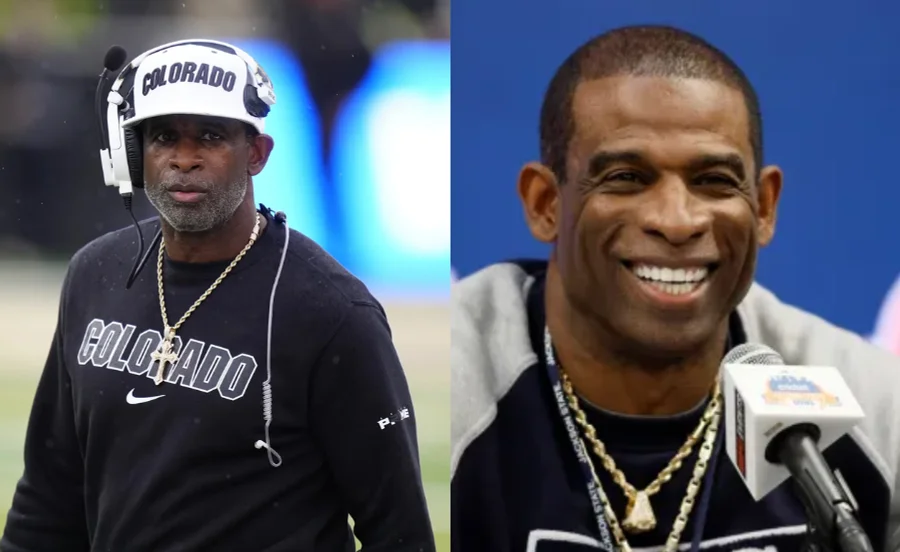

Deion Sanders is a legendary American football and baseball athlete widely known by his nickname “Prime Time.” Born on August 9, 1967, in Fort Myers, Florida, he became one of the rare athletes to play professionally in both the NFL and Major League Baseball at the same time. During his football career, Sanders played for teams including the Atlanta Falcons, San Francisco 49ers, Dallas Cowboys, Washington Redskins, and Baltimore Ravens. Known for his incredible speed, confidence, and playmaking ability, he won two Super Bowl titles and was inducted into the Pro Football Hall of Fame in 2011.
After retiring from professional sports, Deion Sanders moved into coaching, broadcasting, and business ventures. He gained national attention as head coach of Jackson State University before becoming the head coach of the University of Colorado Boulder football team, where he quickly transformed the program’s popularity and recruiting power. Beyond football, Sanders is also known for his outspoken personality, motivational leadership style, and strong influence on young athletes. Despite facing health challenges in recent years, including multiple foot surgeries, he remains one of the most recognizable and influential figures in American sports culture.
Also More : Samuel Jason Black
Bio Table — Everything You Need to Know
| Category | Detail |
| Full Name | Deion Luwynn Sanders Sr. |
| Date of Birth | August 9, 1967 |
| Birthplace | Fort Myers, Florida, USA |
| Nicknames | Prime Time, Neon Deion, Coach Prime |
| Nationality | American |
| Height | 6’1″ (185 cm) |
| Parents | Mims Sanders and Connie Sanders (divorced when Deion was 2) |
| Stepfather | Willie Knight — influential in his upbringing |
| High School | North Fort Myers High School |
| College | Florida State University |
| Drafted (NFL) | 5th overall pick — Atlanta Falcons, 1989 |
| NFL Teams | Atlanta Falcons, San Francisco 49ers, Dallas Cowboys, Washington Redskins, Baltimore Ravens |
| NFL Career | 14 seasons (1989–2005) |
| NFL Stats | 53 interceptions; 8 Pro Bowls; 6 All-Pro selections |
| Super Bowl Wins | 2 (San Francisco 1994 season; Dallas 1995 season) |
| MLB Teams | New York Yankees, Atlanta Braves, Cincinnati Reds, San Francisco Giants |
| MLB Career | 9 seasons as outfielder |
| Unique Record | Only athlete to play in both a Super Bowl and a World Series |
| NFL Earnings | ~$45 million across career |
| MLB Earnings | ~$13 million across career |
| Hall of Fame | Pro Football Hall of Fame — inducted 2011 |
| Coaching (HBCU) | Jackson State University — Head Coach 2020–2022 (27–6 record) |
| Coaching (D1) | University of Colorado Buffaloes — Head Coach 2023–present |
| Colorado Contract | 5-year, $54 million extension signed March 2025 |
| Annual Salary (2025) | $10 million per year |
| Net Worth (2025) | $45–$60 million (estimated) |
| Children | 5 — Deiondra, Deion Jr., Shilo, Shedeur, Shelomi |
| Marriages | Carolyn Chambers (1989–1998); Pilar Biggers-Sanders (1999–2013) |
| Current Partner | Tracey Edmonds (relationship confirmed publicly) |
| Health | Two toes amputated (2021, blood clot complications); bladder cancer diagnosed and treated successfully (2025) |
| 5.5+ million followers | |
| Twitter/X | 1.8+ million followers (handle: COACH PRIME) |
| Religion | Devout Christian — faith central to public identity |
| Documentary | Coach Prime on Prime Video (2022–present) |
| Net Worth | Estimated $45–$60 million (2025) |
Growing Up in Fort Myers When the Stage Was Already Set
Did you know Deion Sanders was just two years old when his parents separated? He was raised by his mother, Connie, and her husband, Willie Knight, a man Deion has spoken about with deep respect. Not bitterness. Not resentment. Genuine gratitude. Because Willie Knight stepped in and showed up, and that meant everything to a kid growing up in Fort Myers, Florida, with limitless physical gifts and no blueprint for what to do with them.
At North Fort Myers High School, the picture was already becoming clear. He played football. He played baseball. He played basketball. He earned all-state honors in all three. In 1985, the Florida High School Association named him to its All-Century Team, the top 33 players from 100 years of state high school football. He was still a teenager.
From Fort Myers, he headed to Tallahassee and Florida State University. The Seminoles were about to get one of the most complete athletes they had ever seen. He played cornerback on the football team. On the baseball team, he was an outfield player. He ran track. All at the same time. All at an elite level.
By the time the NFL draft arrived in 1989, there was no mystery about where he was going. The Atlanta Falcons took him fifth overall. Prime Time was about to meet the professional world, and the professional world had absolutely no idea what it was in for.
The NFL Career Rewriting What a Cornerback Could Be
Before Deion Sanders, the cornerback position had a specific profile. Fast, yes. Physical, yes. But contained. Functional. A position whose job was to stop things from happening rather than make things happen. Deion Sanders changed that definition entirely and did not ask anyone’s permission.
He played with a kind of theatrical confidence that had never been seen at the position before. He talked. He celebrated. He wore his personality on his sleeve and then on his helmet, his cleats, and his jewelry. And he backed every single word of it up with plays that left coaches speechless and opposing offenses planning their entire game around simply not throwing the ball to his side of the field.
His statistical record tells part of the story: 53 career interceptions, 8 Pro Bowl selections, and 6 First-Team All-Pro designations. But the numbers cannot fully describe what it felt like to watch him play. Wide receivers who lined up against him describe it as a psychological battle before any physical one even began.
He won his first Super Bowl ring with San Francisco at the end of the 1994 season. Less than a year later, he signed with the Dallas Cowboys in a contract so enormous and structured so creatively that the NFL changed its salary cap rules specifically because of it. The league literally created a new regulation named after him. Then he went out and won a second Super Bowl ring with Dallas. By the time he retired officially following the 2005 season with the Baltimore Ravens, he had left a permanent mark on how the position was understood, coached, and celebrated.
The Baseball Career Because Why Not?
Here is where the story goes from impressive to almost unbelievable. While playing NFL football at a Hall of Fame level, Deion Sanders was also playing professional baseball. Not at the minor league level as a hobby. In the majors. In October of 1992, he played in both an NFL game and an National League Championship Series game on the same day. He flew between cities to make it happen.
Did you know he is the only person in the history of American professional sports to play in both a Super Bowl and a World Series? Only one human being has ever done that. His name is Deion Sanders.
Over nine MLB seasons, he appeared for the New York Yankees, Atlanta Braves, Cincinnati Reds, and San Francisco Giants. He played outfield, used his extraordinary speed to cover ground that most outfielders could not reach, and earned a reputation as a legitimately skilled baseball player, not a football star moonlighting, but a genuine two-sport professional at the highest level of both. The baseball contracts added roughly $13 million to his career earnings across those nine seasons. Not the primary income stream, but real professional money earned in a completely separate demanding sport.
The Coaching Chapter “Coach Prime” Takes Over
When Deion Sanders retired from playing, most people assumed the next chapter would be broadcasting. He had the presence. He had the personality. He joined the NFL Network as a studio analyst and proved immediately that he could hold an audience off the field, too. But broadcasting was not the final destination.
In 2020, he took over as head coach at Jackson State University, a historically Black college and university in Mississippi. This was not a prestigious Power Five opportunity. It was a calculated decision, and the football world paid attention. He wanted to put HBCUs on the national recruiting map. He wanted to show that elite talent could be developed and celebrated at schools that had long been overlooked.
He delivered. Jackson State posted a 27-6 record during his three-season tenure. He attracted Travis Hunter, a five-star recruit who became the first such recruit to sign with an FCS program. It was described by recruiting analysts as one of the most stunning signing-day moments the sport had ever produced.Then came Colorado. The University of Colorado had finished the 2022 season with one win and eleven losses. The program was broken. They hired Deion Sanders on a five-year, $29.5 million deal and handed him the keys.
His first season produced a 4-8 record. His second season? Nine wins and four losses. The turnaround was real. Travis Hunter followed him from Jackson State to Colorado, won the Heisman Trophy in 2024, and was selected second overall in the 2025 NFL Draft by the Jacksonville Jaguars. In March 2025, Colorado rewarded that progress with a five-year, $54 million contract extension. His salary jumped to $10 million per year, putting him among the highest-paid college football coaches anywhere in the country.
Personal Life: The Family, the Health Battles, the Faith
Deion Sanders has been married twice. His first marriage to Carolyn Chambers lasted from 1989 to 1998. Together, they had two children: Deiondra and Deion Jr. His second marriage to Pilar Biggers-Sanders ran from 1999 to 2013 and produced three more children: Shilo, Shedeur, and Shelomi.
The second divorce was contested and drew extended media coverage. A Texas court ultimately awarded him sole custody of his two sons and joint custody of his daughter. As of 2025, he is in a relationship with Tracey Edmonds, a television producer and Emmy Award-winning executive.
His children have followed him into sports in striking ways. Shedeur Sanders played quarterback at Colorado under his father and was selected by the Cleveland Browns in the fifth round of the 2025 NFL Draft, a pick that generated enormous national conversation. Shilo Sanders played safety at Colorado as well, went undrafted, and signed with the Tampa Bay Buccaneers as a free agent before being released in preseason.
The health challenges have been real and serious. In 2021, complications following surgery on a dislocated toe led to dangerous blood clot complications, resulting in two toes being amputated. He returned to coaching before most people expected. Then in 2025, he announced a bladder cancer diagnosis, and shortly after, confirmed he was cancer-free following successful surgery. Through all of it, he has spoken publicly and without self-pity, crediting his Christian faith as his anchor through every difficult moment.
Net Worth and the Money Behind “Prime Time”
Deion Sanders’ net worth in 2025 is estimated at between $45 million and $60 million, with most recent assessments landing around $60 million when factoring in the new Colorado extension. The financial picture across his career breaks down roughly like this: approximately $45 million from NFL contracts across 14 seasons; approximately $13 million from nine MLB seasons; and endorsement income across multiple decades from major brands including Nike, Pepsi, American Express, Burger King, Pizza Hut, and Under Armour.
His coaching salary now represents his largest active income stream, $10 million annually through 2029, climbing to $12 million in the final year of the deal. Add in his ongoing brand work, his presence on the Coach Prime documentary series on Prime Video, and his media appearances, and the income picture remains substantial.
At his playing peak in the late 1990s, his combined football and baseball income put him among the highest-earning athletes anywhere in professional sports. The signing bonus alone from his Dallas Cowboys deal structured partly to navigate salary cap rules was nearly $13 million, a figure that forced the NFL to rewrite its own regulations.
Social Media and Public Image
Deion Sanders does not approach social media casually. He uses it with the same intention he brings to everything else. On Instagram, he has more than 5.5 million followers. His posts range from motivational messages directed at his Colorado players to behind-the-scenes looks at practice sessions to personal moments of faith and family. On Twitter/X, he operates under the handle “COACH PRIME” and maintains over 1.8 million followers.
His public image in 2025 is layered. He is simultaneously the Hall of Fame cornerback, the two-sport legend, the HBCU champion who put Jackson State on the national map, the polarizing college football coach, the devoted but complicated father, the cancer survivor, and the man who turned a reality documentary into one of Prime Video’s most talked-about sports series. He is not a simple brand. He is a full, complicated, always-moving story, and he has never tried to make himself smaller for anyone’s comfort.
Read More: John Edward
FAQs
1. What is Deion Sanders’ net worth in 2025?
Estimates range between $45 million and $60 million. The most frequently cited figure is $60 million, reflecting his NFL and MLB career earnings, long-running endorsement deals, and his current Colorado coaching contract worth $54 million over five years.
2. Is Deion Sanders the only athlete to play in both a Super Bowl and a World Series?
Yes. He holds that distinction uniquely. No other professional athlete in American sports history has competed in both a Super Bowl and a World Series. He accomplished both across his dual NFL and MLB careers.
3. How much does Deion Sanders make as Colorado’s head coach?
Following his March 2025 extension, he earns $10 million per year for 2025 and 2026, rising to $11 million for 2027 and 2028, and $12 million in 2029 placing him among the highest-paid college football coaches in the country.
4. What were Deion Sanders’ most important NFL teams?
He played for five franchises: Atlanta Falcons, San Francisco 49ers, Dallas Cowboys, Washington Redskins, and Baltimore Ravens. His two Super Bowl wins came with San Francisco (1994 season) and Dallas (1995 season).
5. Did Deion Sanders really play baseball and football on the same day?
Yes. On October 11, 1992, he played in an NFL regular-season game and an NLCS playoff game within the same 24-hour period, traveling between venues to make it happen. It remains one of the most remarkable single-day achievements in American sports history.
6. What happened to Deion Sanders’ health?
In 2021, complications from a foot surgery led to blood clot issues that required two toes to be amputated. He returned to coaching relatively quickly. In 2025, he announced a bladder cancer diagnosis and later confirmed he had undergone successful surgery and was cancer-free.
Final Words
Deion Sanders built a career that few athletes in history could ever match. From dominating NFL fields as one of the greatest cornerbacks of all time to playing Major League Baseball at the same time, he turned versatility into a legacy. His confidence, speed, and larger-than-life personality made him more than just a sports star he became a cultural icon who changed how athletes could market themselves, lead teams, and inspire younger generations. Whether as “Prime Time” on the field or “Coach Prime” on the sidelines, Sanders always carried the same belief: never think small when your talent can change the game.
Today, Deion Sanders stands as more than a Hall of Fame athlete. He is a coach, mentor, father, businessman, and survivor who has continued pushing forward through serious health battles and personal challenges. His impact on college football, especially through programs like Jackson State University and the University of Colorado Boulder, has reshaped recruiting, media attention, and opportunities for young athletes. His story is ultimately about ambition, resilience, faith, and refusing to live within limits that other people try to set.